
Latest News

The last battles of Lasith Malinga
Thursday, 31 May 2018 - 15:22 | Views - 1,329
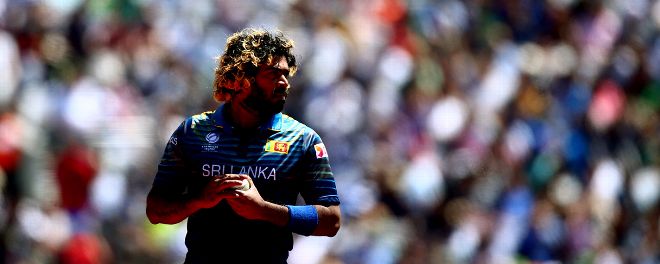
All through his career he has defied convention, and authority. And as the greatest T20 bowler the world has seen reluctantly winds down, he does so his own way
Lasith Malinga wants to know where he should field. In the previous over he was at deep cover, which was perhaps an oversight. When a ball was struck directly at him he collected cleanly enough, but the batsmen still looked for a second.
He soon gets the captain's attention and has himself stashed away at short fine leg. This is to no avail. The batsman flicks, and the ball comes at Malinga again, this time a little to his left and at pace. He dives. Well - falls over. By the time he hits the ground, the umpire is already preparing to signal a boundary.
The low-slung Mirando Stand at the P Sara Oval is an old-world delight. Mahogany benches filled in with rattan weave stretch out beneath rows of skinny ceiling fans. Behind the seating, pale yellow columns crowned with flowery capitals hold up a tiered takaran roof. From across the ground the scoreboard glints, its flanking walls wrapped in ivy.
For as long as international sides have played here (which for this ground is many decades; Don Bradman's Invincibles visited in 1948), photographers have parked themselves in front of thisstand to use that scoreboard for a backdrop. But this is not an international match. This only barely qualifies as professional cricket. In fact, it is possible the tournament would not have been played at all had this not been an SLC election year, and had the office-bearers not required a reason to bestow grants on clubs for votes.
So at 34 years of age, the format's greatest ever bowler is playing in this - a bloated, hashed-together T20 competition of embarrassingly modest quality. Worse, he is being picked apart in the Mirando stand.
The crowd of about a hundred comprises mostly supporters of the Army Sports Club, whom Malinga's Nondescripts Cricket Club are facing. Not everyone is unsympathetic. "Fellow has injuries, no?" says one man. "Can't expect him to stop every bloody thing." A friend quickly argues the other side, because when it comes to Malinga, there is always another side. "What injuries ado? Look at his body. Does he look like a cricketer? Shame to see him like this even." A third voice, engaged in a different conversation, rises above the hubbub. "Could have nicely played for another two years, no? He is only to blame. Might have survived if he wasn't such a pandithaya - such a know-it-all."
A few overs later, Malinga gets the ball in hand, and suddenly the stand hushes down. Gazes that have strayed from the cricket return. One man retrieves a camera from his bag and begins to click. Even after all these years this much is still a spectacle.
Malinga kisses the ball, begins his approach, and his feet come slowly off the ground as they have since his youth on the southern coast, like they are forever being picked out of an inch of wet sand. At the crease, he gets into his explosive delivery stride and begins with the yorker - a ball he has bowled since those early days. A familiar sequence follows. The slower one he picked up through the mid-aughts, rolling his fingers beneath the ball. One back-of-a-length quick delivery, which used to be his Test-match stock ball. Two slower yorkers, the batsman halfway through the shot before making the adjustment. Then a bouncer to finish off. They score only one run off the over, but then they are tailenders. Malinga's two wickets at the top of the innings had already sparked a collapse.
Next over, at the top of his mark, Malinga looks the ball over, switches the shiny side so it points to leg, and sets off on another ambling approach. Reverse swing has always come easy to him. Not only does his low-arm action perfectly suit the craft, he also bowls with a tilted seam in the early overs, which naturally scuffs one side up. What's more, where for others reverse swing usually grants lateral movement, the ball's angle out of his hand means the swing pulls up-to-down for Malinga. He literally reverses the ball into the ground.
During Malinga's most exquisite years, even batsmen who knew they were about to be yorked were routinely powerless to prevent the rattling of their stumps. Deliveries that should have arrived at shin height ducked beneath bats, ricocheted off toes, clattered into stumps.
Malinga has since traded a few kph for several kg, but the skill - oh man, it is as it ever was. First ball of his final over, he has the ball plunging mid-pitch. As it dives, it also tails, right into leg stump, the flashing bat never threatening to interfere. He finishes with figures of 3 for 14. He would end the tournament as joint-highest wicket-taker.







Monday, 27 July 2026 - 9:40
After years dominated by hyper-saturated trend cycles and sleek, ultra-smooth minimalism, fashion has...

Monday, 20 July 2026 - 9:35
The era of hyper-rigid seasonal dress codes has quietly dissolved. Where personal style once demanded...

Monday, 08 June 2026 - 18:35
There was a time when sleek, unadorned surfaces and flat printed graphics defined what it meant to be...



Thursday, 13 August 2026

Wednesday, 05 August 2026

Thursday, 30 July 2026


Tuesday, 18 August 2026

Tuesday, 28 July 2026

Monday, 20 July 2026

Friday, 15 May 2026