
Latest News

Shane Warne gave us so much and he had so much more to give
Tuesday, 08 March 2022 - 21:23 | Views - 479
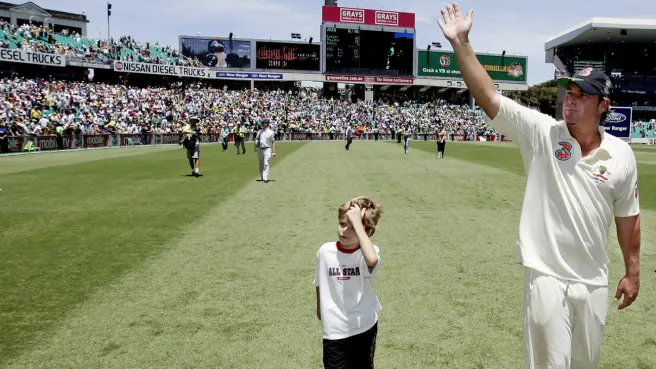
He was cricket and he was rock 'n roll too; he was the best of sport and he was the stuff dreams are made of
There was something elemental about Warnie - like the wind and the rain, or the sun. He could be a wild and unpredictable ride and he could be a warm and kindly neighbour. He brought things into our lives that were unique and he illuminated the spaces we occupied; none of us would suggest that we were anything but lucky to stand in that light. It wasn't quite exclusively his world in which we lived, but it wasn't far from it.
Shane loved Springsteen's music and especially that most recent album, Letter to You. It finishes with a song called "I'll See You in My Dreams", which is a eulogy of sorts to a friend who has passed, and which Shane said made him cry. Now the tears are ours, for the loss of an irreplaceable brother-in-arms.
He loved rock music in general: thus the heading of each chapter of his autobiography with titles such as "Satisfaction", "Imagine", "Heroes" and "The Rising". He would turn up the volume at home, by the pool or in the car and pound it out, singing the choruses as if he were in the crowd at the Melbourne Cricket Ground, the stadium that was his spiritual home. Mostly, he was a man of popular culture but his take on it was rooted in the tradition and memories of the past. No one had better manners nor offered more polite answers to seemingly endless requests - appearances, autographs, selfies, interviews and functions - while always guarding cricket's history and conscience.
The outpouring since the news of his death has stretched far and wide and is still doing so. The Times of London gave him 14 pages but he was front cover in Malaysia too. He was cricket and he was rock 'n roll too; he was the best of sport and he was the core of aspirational dreams. He fed us the oxygen of the game in the most engaging and fascinating ways, changing perception, inviting debate, encouraging enthusiasm, breathing hope and never surrendering. We owe him so much.
"What's the key to being a good legspinner, Warnie," was the question. "A lot of love," came the answer. "What's the art of legspin, Warnie?" To which he would reply, "The creation of something that isn't there, mate."
It was my privilege to know him well and to frequently stay with him in Melbourne, in the various houses he loved to trade - up, and down, I should add. I was with him at home in December 2003 during the ban for the diuretic pill he took just prior to the World Cup in South Africa earlier that year. After the first night, I woke early but there was no sign of him. He walked through the door at 7.30-ish, clad in tracksuit and trainers.
"Been for a run?"
"No mate, been having a bowl at an indoor school out on the edge of town."
"But you're not allowed to."
"I know. Wanna come with me tomorrow and have a hit?"
"Sure."
Later that day, after tennis, at which he was damn good, by the way, I asked him about these early mornings. He said he knew the fella who ran the indoor school and talked him into opening up at 6am so he could bowl for an hour a couple of times a week before anyone else in Melbourne had put the kettle on. The place was locked up again by seven and first arrivals weren't till eight. For one period of his life, at least, he flew under the radar; albeit reluctantly, for it was during this forced sabbatical that Kerry Packer told him to lie low awhile and sell the red Ferrari. So he did. And bought a blue one.
"Did you sell the red Ferrari, son?"
"I did, Kerry."
Anyway, back to the indoor school. A handkerchief to aim at was okay but a batter was better, and by great good fortune, that man with the willow was me. I borrowed his kit and padded up. As I write, I'm trying to imagine myself there - more than 18 years ago - nervous as a kitten. When Hampshire played the Australians in 1993, he was rested (well, he wasn't at the game!), so I had never faced him.
The first thing that struck me was the aura, even at the start of his eight-pace shuffle and approach. I remember the rhythm of the approach, the power of the delivery stride and the symmetry of the action. I remember the flight of the ball and the hardness as it hit the bat or body: they say some seamers bowl a "heavy" ball, so did Warne. I remember the revolutions, the high bounce off the hard synthetic surface and the need to react quickly and definitively. I was surprised at how fast he bowled and how, when he bowled "up" (above the eyeline), the ball dipped at the last second and panicked the response. It didn't spin so much off that surface so I asked if it was like bowling at the WACA in Perth. Not really, he said, the ball skids off the WACA pitch, so it's easier to bat against me there than in here: "In here, Markie, the bounce will getcha…"
The ball hit the splice a lot and sent a fizzing sensation up the handle and into the bottom hand, so I adapted at each session by playing softer and softer, later and later. I found it very difficult to get down the pitch and meet the ball as it landed and so persuaded myself to play back more. It occurred to me that a better player would manage the shimmy down the pitch with more skill and faster footwork, and that the good sweepers would have to take him on in the way that Kevin Pietersen managed so successfully on occasions.
He hit the pad so often it was a joke - that slider! He even tried a few flippers, the stuff of gold. But no wrong'uns - aka googlies - because of his shoulder. On the second morning I goaded him into bowling one and he winced in pain. I mainly blocked because there were so few bad balls, occasionally slogged over wide mid-on and cut backward of point a bit. One or two drives, straight and through mid-off, were highlights. This was a kingdom of days, Warne and me, cutting it as the dawn broke in his home town.
I remember thinking how good the really good players must be, the few who made big runs against him - Sachin Tendulkar and Brian Lara, specifically. I was barely getting a hint of the overall show - just a little side spin, no wear in the pitch or footmarks, no close fielders (though he did set an imaginary field, but of course, fiction is fiction), no mind games, no crowd, no abuse, no TV or radio, no snappers, no reports the next morning, no pressure on the outcome, no representation of your team or country, no backstory, no scoreboard threat, no behind-the-game panic, no Ian Healy or Adam Gilchrist in your ear and so forth.
And I very well remember marvelling at the level of skill in what he did and the power with which he did it. I saw at first hand how the 10,000-hour theory rolled out. He was astonishingly gifted at something extremely difficult - and he knew it - and he practised relentlessly to perfect it and rejoiced in taking it to the world.







Monday, 19 October 2026 - 10:25
The sixth annual Academy Museum Gala lit up Los Angeles as stars gathered in support of the Academy Museum...

Monday, 12 October 2026 - 12:07
Paris Fashion Week SS27 has officially declared minimalism over, ushering in a breathtaking era of high-impact...

Monday, 05 October 2026 - 11:00
Paris Fashion Week has been nothing short of a whirlwind, turning the French capital into the ultimate...



Thursday, 15 October 2026
Wednesday, 07 October 2026

Thursday, 01 October 2026


Friday, 16 October 2026

Wednesday, 07 October 2026

Thursday, 01 October 2026

Tuesday, 18 August 2026