
Latest News

Loose Pass: Cards and why Warren Gatland got it right
Wednesday, 12 May 2021 - 15:16 | Views - 480
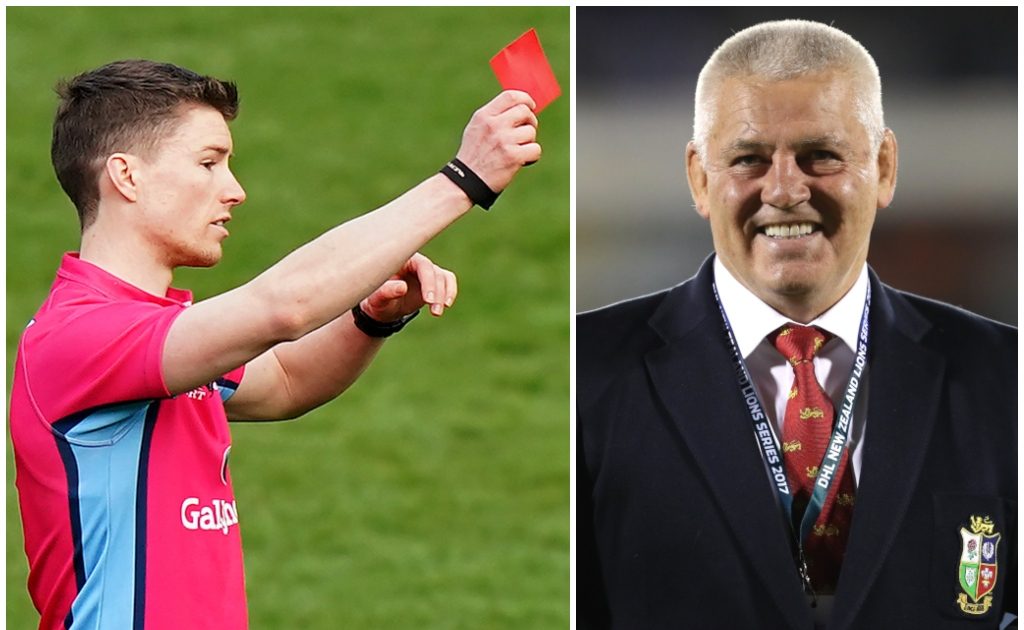
This week we will mostly be concerning ourselves with cards, British & Irish Lions and a little non-Lions armchair punditry…
Too many cards, not enough change
It was perhaps initially to be expected given the strength of the crackdown, but it is starting to become a bit of a thing now, the number of cards being flourished around in rugby.
This weekend in the Premiership alone we saw ten yellow and two red cards. Two cards a game? It’s getting to the stage where a team should be looking at the statistics and anticipating at least one ten-minute phase where they’ll be playing a man down – assuming the opposition has a full contingent to play against.
The red cards have become a problem to the extent that some tournaments have trialled measures whereby the player sent from the pitch cannot return but can be replaced 20 minutes later, thus negating pretty much the entire point of the red card in the first place: severely punishing a team for an individual’s serious transgression.
This is not, however, a criticism of officiating. Goodness knows referees have it hard enough, but by and large the TMOs and trios surrounding the matches are making a decent fist of noticing the misdemeanours deserving ultimate sanctions.
This is very much a criticism of a huge number of players however, who simply will not learn. We are seeing time and time again how players are simply not bending into the tackle as they should, nor wrapping as they should, nor refraining from tipping as they should. Sometimes it is unavoidable, but it’s been a long time since we saw a truly dangerous situation being unavoidable somehow. When are players going to learn?
The same applies to an extent to the lawmakers. In the Six Nations especially, we saw at least two red cards for highly aggressive clean-outs on players jackalling for the ball or guarding rucks. Yet in both of those situations, the risk comes because, in the case of the jackaller he is bent over nearly double over the ball and exposing his upper back and neck to any impact, while in the case of the ruck guard, he is allowed to bind on to the player on the ground, enabling him to absorb the impact without being cleaned off the ball much more easily.
Enabling him to absorb the impact? Isn’t it impacts – to that part of the body at any rate – we are trying to eradicate with the zero-tolerance policy from officials we are now seeing? Meanwhile, crocodile rolls – yes, those ones that look as though they are about to wreck knees at any moment – continue to be used as a legitimate cleaning technique.
There can only be so many red cards, over and over again, before rugby has to look at the situation and wonder if it might not be better to prevent such collisions at source rather than just enforcing the measures to punish it. That would mean no jackalling, no binding onto the man on the ground, rather ensuring that ruckers ruck and counter-ruck by pushing and driving, not wrestling or thumping.
We’ve given officials licence to punish, but it seems not to be working. The lawmakers need to ensure that the opportunities for dangerous play are snuffed out better.
The Lions on the toughest tour of all
And so the cards are on the table. No Kyle Sinckler, no Jonathan Davies, no Billy Vunipiola, no Johnny Sexton or Marcus Smith but surprises in Chris Harris, Bundee Aki, Rory Sutherland and Courtney Lawes.
Physicality and pragmatism has been the watchword in almost every aspect of this side, as well as mental toughness. Warren Gatland once described Sinckler as an emotional time-bomb and although the Bristol and England prop has been much more mature of late, Mr. Gatland may have looked not only at game-play, but also the pressures of being stuck inside a bubble for six weeks and decide that any detonation of that time-bomb might be too damaging.
Likewise he would have looked at Sexton’s recent injury sheet and concluded that South Africa, more than any other team, could be a level of physicality too far for Ireland’s veteran. Nearly all the surprise picks, or tough-choice picks look to have been made on the basis of a balanced mixture of physical and mental toughness; there is an absence of anyone who might take a step back physically on the pitch, or of anyone who might crack under the unique pressures of being inside the bubble.
This is not as talented a side as the Lions could have offered, but it is the strongest. A suitable squad for a tour which could prove to be an ultimate mental and physical test.
A warm-up side
There are of course, those who missed out. How about this for a team of outsiders to take on the Test team for a warm-up game (players missing out for any reason included)?
15 Keith Earls, 14 George North, 13 Jonathan Davies, 12 Cameron Redpath, 11 Jonny May, 10 Marcus Smith, 9 Ben Youngs, 8 CJ Stander, 7 Josh Navidi, 6 Jamie Ritchie, 5 James Ryan, 4 Jonny Gray, 3 Kyle Sinckler, 2 George Turner, 1 Ellis Genge







Monday, 19 October 2026 - 10:25
The sixth annual Academy Museum Gala lit up Los Angeles as stars gathered in support of the Academy Museum...

Monday, 12 October 2026 - 12:07
Paris Fashion Week SS27 has officially declared minimalism over, ushering in a breathtaking era of high-impact...

Monday, 05 October 2026 - 11:00
Paris Fashion Week has been nothing short of a whirlwind, turning the French capital into the ultimate...



Thursday, 15 October 2026

Wednesday, 07 October 2026

Thursday, 01 October 2026


Friday, 16 October 2026

Wednesday, 07 October 2026

Thursday, 01 October 2026

Tuesday, 18 August 2026