
Latest News

Journey into stats: how did they do it?
Friday, 21 September 2018 - 9:00 | Views - 915
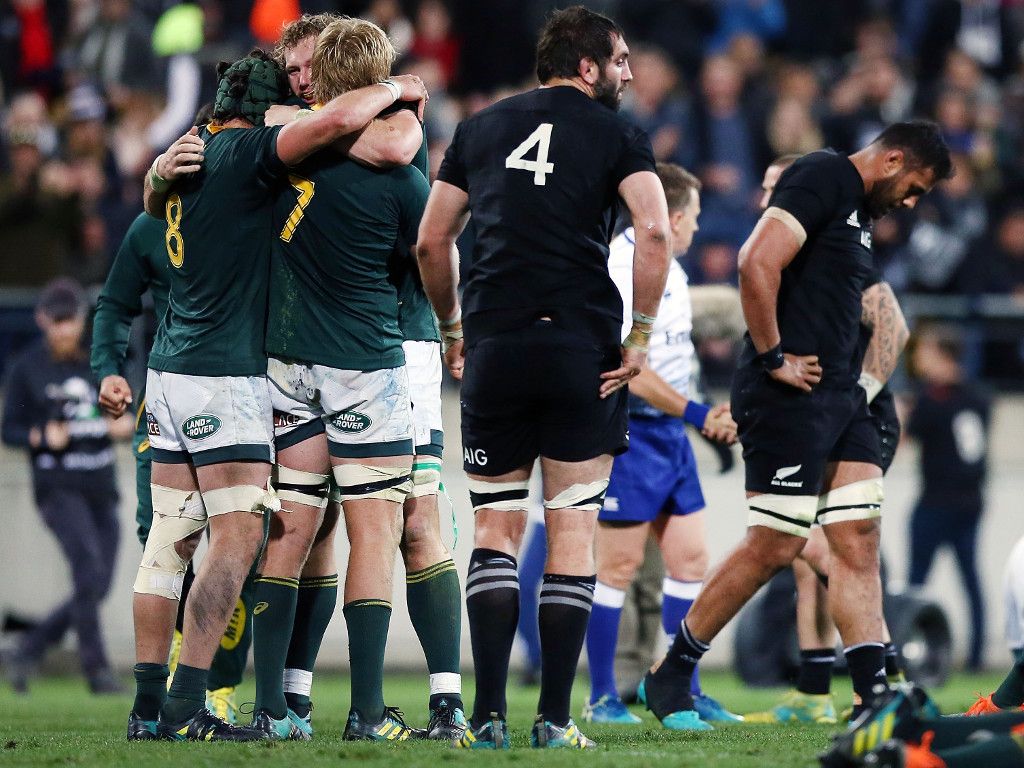
A momentous occasion in Wellington on Saturday was realised just by the only numbers that really count: 36 points to South Africa, 34 to New Zealand.
But a look even at just the most basic stats from the Rugby Championship game told a story far more epic.
TRIES
New Zealand – 6
South Africa – 5
METRES CARRIED
New Zealand – 633
South Africa – 245
CARRIES
New Zealand – 205
South Africa – 59
DEFENDERS BEATEN
New Zealand – 33
South Africa – 10
PASSES
New Zealand – 234
South Africa – 61
OFFLOADS
New Zealand – 17
South Africa – 3
POSSESSION
New Zealand – 75.3%
South Africa – 24.7%
TACKLES
New Zealand – 46
South Africa – 226
RUCKS WON
New Zealand – 153
South Africa – 40
SCRUMS WON
New Zealand – 13
South Africa – 7
LINEOUTS WON
New Zealand – 9
South Africa – 6
PENALTIES CONCEDED
New Zealand – 3
South Africa – 10
YELLOW CARDS
New Zealand – 0
South Africa – 1
In not one single one of the above metrics did South Africa win this match bar offloads. So how did they win this game exactly?
Clearly New Zealand can point the finger at Beauden Barrett’s profligacy from the tee, but that is a simplistic view and something of a scapegoating; on the basis of the stats above, New Zealand should have won by miles.
Just as clearly, you could look at the fact that the Boks counted two interceptions among their five tries. Not so much luck as bad decision-making from the All Blacks in both cases, as was the decision to ignore at least two capable drop-goal kickers in the final minutes, but still a significant swing. But even so, with that much possession and territory, no team should lose.
Watching the game replay, it was hard to escape the notion that the game was scrappier in the cold light of day than it might have been perceived during the thrill of watching it live. Bodies flew everywhere at rucks, some of the hits were jarring and the rucks were significantly less systematic in terms of players arriving and momentum than coaches might have liked.
All of which suggests it was a game in which defences were to the fore. So we considered how might be a good way of measuring defence more accurately, then looked at both the amounts of possession, territory and carries and wondered if gainline efficiency could give us an accurate pointer.
It certainly did. South Africa’s defence, and most pertinently the combination of line speed and accuracy in both defining early who the ball carrier was and tackling him immediately was magnificent.
New Zealand’s defence on the other hand was surprisingly passive. Despite meagre possession, South Africa were regular gainline beaters.
In the first-half, we counted 64 structured phases of New Zealand possession, of which only 34 made it over the gainline. By contrast, South Africa had only 25 phases, but 18 made it over the gainline.
In the second-half, the All Blacks got a little better, but only a little. Of their 100 – one hundred – phases of structured possession (i.e. not from a kick or picking up a handling error), 62 made it past the gainline. South Africa’s rather paltry 12 phases – twelve in an entire half of rugby – yielded eight gainline crosses.
Ultimately, New Zealand had a mere 58 per cent gainline success in this match, which, considering the South Africans had to defend 164 phases of structured possession over the 80 minutes, or around 50 of live game time, is an extraordinary defensive effort.
As if to illustrate, the All Blacks scored a try for each 27.3 phases of structured possession. South Africa managed one every 12.3. Whatever else, the Boks defended well and New Zealand were rather passive, making the Springboks clearly more efficient.
Yes, Barrett missed his kicks. Yes the Boks lived on their wits with the intercepts. Yes, shouldn’t the All Blacks have dropped a goal (haven’t they learned?)
But you can’t knock this defensive effort, which likely counted for more than those aspects put together.







Monday, 27 July 2026 - 9:40
After years dominated by hyper-saturated trend cycles and sleek, ultra-smooth minimalism, fashion has...

Monday, 20 July 2026 - 9:35
The era of hyper-rigid seasonal dress codes has quietly dissolved. Where personal style once demanded...

Monday, 08 June 2026 - 18:35
There was a time when sleek, unadorned surfaces and flat printed graphics defined what it meant to be...



Thursday, 13 August 2026

Wednesday, 05 August 2026

Thursday, 30 July 2026


Tuesday, 18 August 2026

Tuesday, 28 July 2026

Monday, 20 July 2026

Friday, 15 May 2026