
Latest News

Oxford Shoes
Monday, 26 August 2019 - 16:14 | Views - 964
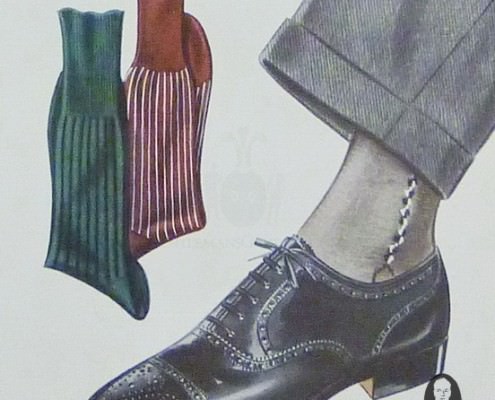
In the recent past, we covered various types of men’s boots and shoes, both formal and casual. In our Brogues Shoe Guide for Men, we touched lightly upon the difference between Oxford and Derby shoes, and today we’d like to focus our full attention on the Oxford, which is often referred to as the most elegant type of men’s shoe – for a good reason!
What Makes an Oxford an Oxford?
Unlike most other shoes and items of menswear, the Oxford shoe has one principal defining characteristic: the lacing system. Sometimes people use the term Oxford to denote any smart lace up shoe, even those with open lacing, but that’s not how we will use the term in this guide.
The eyelets for the shoe laces are generally located on the quarters (with the exception of a wholecut and seamless shoe). For a closed lace system, the vamp is sewn on top of the quarters and the shoelace eyelets facings are stitched underneath the vamp. The shoelaces are used to tie the two quarters together thus fastening the shoe onto your foot. When a shoe is new, the quarters should form a narrow V-shape and once they are worn in, the V should disappear so the quarters touch each other, and you can only see the tongue at the top end. Most British Oxford shoes today, mostly have 5 eyelet holes on each side, whereas American Oxfords often have 6. In the past 4 or even 3 eyelets per side were not uncommon, and so it boils down to personal taste.
History of the Oxford shoe
During the 17th-century men’s footwear was dominated by boots. Often high and tightly fitting with buttons instead of laces, they were worn both outdoors and indoors. More often than not these boots featured rather high heels, a style popularized by King Louis XIV of France, who was of modest height. At that time, France was the cultural epicenter in Europe and hence most gentlemen aligned their sartorial choices with the French Court, and footwear was no exception.
However this style of footwear was very comfortable and although it is not entirely clear who exactly invented the Oxford shoe, it seems plausible that the students Oxford University popularized a “half boot” called the Oxonian Shoe around 1825. At first, the Oxonian shoe featured narrow slits on its sides which made it much more comfortable to wear around campus than the high boots then in fashion. Slowly over time, the side slits were replaced with laces (on the sides). These side laces eventually made their way to the instep of the boot. Further changes included lowering of the heel and the height of the boot being lowered to expose the ankle. It is still a matter of debate as to whether all these changes took place on campus, which seems highly improbable.







Monday, 27 July 2026 - 9:40
After years dominated by hyper-saturated trend cycles and sleek, ultra-smooth minimalism, fashion has...

Monday, 20 July 2026 - 9:35
The era of hyper-rigid seasonal dress codes has quietly dissolved. Where personal style once demanded...
Monday, 08 June 2026 - 18:35
There was a time when sleek, unadorned surfaces and flat printed graphics defined what it meant to be...


Tuesday, 25 August 2026

Thursday, 13 August 2026
Wednesday, 05 August 2026


Tuesday, 18 August 2026

Tuesday, 28 July 2026

Monday, 20 July 2026

Friday, 15 May 2026