
Latest News

'It won't be quick': Foreign fighters lend a hand to Ukraine's battle to retake the south
Wednesday, 07 September 2022 - 11:40 | Views - 571
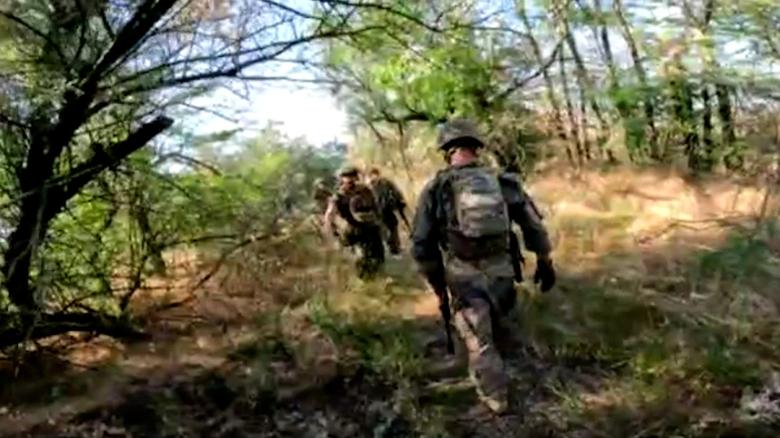
Odesa, Ukraine (CNN)On the first day of the counteroffensive in southern Ukraine, Mark Ayres fired more than 2,000 rounds from his Soviet-designed PK machine gun during fierce firefights with Russian forces.
The former British soldier is working with a reconnaissance unit of the Ukrainian military in the battle to retake the southern region of Kherson, one of only three foreigners in the team.
"The fighting was pretty intense, lots and lots of shelling," Ayres, 48, told CNN. "We fought very hard, and we took the Russian positions that we were meant to take."
Ayres sustained a severe shrapnel wound to his left leg on the second day of the counteroffensive, along with four others who were injured from his unit.
But despite the casualties on the frontline, he said the Ukrainian forces are making slow but definite progress on the ground.
"It won't be quick; it's hard, slow fought, meter by meter, position by position, because we haven't got the resources to do a massive blitzkrieg, with masses of artillery and armor," Ayres said. "So we have to do it smart, and try to do it (by) sustaining as (few) casualties as possible."
So far, the Ukrainians claim to have taken a small handful of settlements in the Kherson region during the offensive, gains which UK intelligence experts said were likely achieved by a "degree of tactical surprise."
Ayres, originally from London, has been fighting alongside former US marine Michael Zafer Ronin, who was also wounded last week at the start of the counteroffensive, suffering shrapnel wounds to the head, stomach and hand.
The pair originally met battling alongside Kurdish fighters in Syria. Now, they are recovering in hospitals in the city of Odesa on the embattled Black Sea coast of southern Ukraine.
34-year old Zafer Ronin, originally from Kansas, said the morale of the Ukrainian military at the frontline is still "fairly high," but in contrast, the opposing Russian forces appear to be "a bit unprofessional, and unorganized."
Zafer Ronin said the morale of the Ukrainian military at the frontline is still "fairly high,"
The two men arrived early in the war as volunteers, and later signed up as paid soldiers for the Ukrainian army on three-year contracts.
Ayres said he came to join the fight because he was "inspired" by the spirit of the Ukrainian people.
"It was (between) right and wrong," Ayres said. "It was an unprovoked attack on a sovereign country." He has no sympathy "whatsoever" for the Russian soldiers, he added.
Their main challenge on the battlefield is being outgunned and outnumbered by their Russian counterparts. The frontline units are well stocked with small arms and ammunition, but short of heavy weapons like artillery and tanks, Ayres said. A limited number of US and NATO-supplied weapons such as HIMARS, Howitzers and Javelin anti-tank missile systems have proved useful in this fight, but they aren't enough to match the firepower of their opponents.
"They just constantly pound us with artillery, so that's what makes it so much harder, the artillery, and the armour that they have, it's superior to ours," Ayres said. "Our strikes are more surgical, but more limited."
On Saturday, a report from the Institute for the Study of War (ISW) said that according to Ukrainian officials, the offensive was "an intentionally methodical operation to degrade Russian forces and logistics, rather than one aimed at immediately recapturing large swathes of territory."







Monday, 27 July 2026 - 9:40
After years dominated by hyper-saturated trend cycles and sleek, ultra-smooth minimalism, fashion has...

Monday, 20 July 2026 - 9:35
The era of hyper-rigid seasonal dress codes has quietly dissolved. Where personal style once demanded...
Monday, 08 June 2026 - 18:35
There was a time when sleek, unadorned surfaces and flat printed graphics defined what it meant to be...



Thursday, 13 August 2026

Wednesday, 05 August 2026

Thursday, 30 July 2026


Tuesday, 18 August 2026

Tuesday, 28 July 2026

Monday, 20 July 2026

Friday, 15 May 2026