
Latest News

Afghanistan conflict: The families caught in crossfire on Helmand front line
Saturday, 17 October 2020 - 5:37 | Views - 562
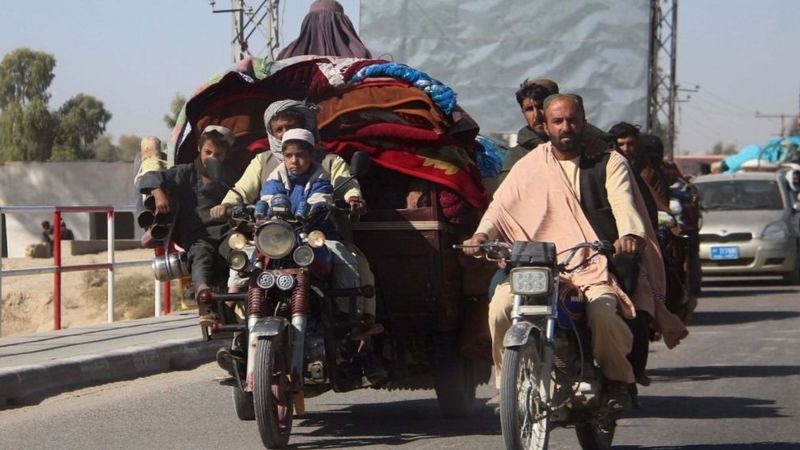
"It was dreadful - the worst ever. Life changed into chaos at once," says Gul Mohammad.
The 25-year-old teacher is struggling to recall how he managed to dodge shellfire and save the 25 members of his family from fighting raging once more in Helmand in southern Afghanistan.
Despite peace talks, a new Taliban offensive is under way. Just a few days before it began Gul Mohammad, whose name has been changed to protect his identity, had been decorating his garden.
As its centrepiece stood a tall tree festooned with balloons - for the family to celebrate the school graduation of their youngest daughter.
"Now our garden is burnt down, for the second time and our house has been turned into a fortress by one side or the other," he told the BBC.
He, his sisters and the rest of the family have all fled - they spent a night on the road before finding shelter with nine other families in a single house in Lashkar Gah.
"We are around 50 people, living in the kitchens and toilets turned into rooms, a tent in the yard and some of us even on the rooftop," he says.
He says he has seen wars but what he witnessed this time he believed belonged only in movies.
The village was one of the first areas to come under attack.
"A rocket landed in our neighbour's house, killing two people. We were close family friends - the rocket killed the 23-year-old mother and her one-year-old son in front of the father."
Gul Mohammad's family fled the area as Taliban fighters closed in. His neighbour had to stay for the funerals.
"We were only 1km away from the shootings, it was dark after evening prayers and I could see exchanges of fire on the streets - bullets were flying over my head. We were just lucky - there was so little separating life from death."
Residents like Gul Mohammad who were lucky enough to escape used whatever transport they could find - buses, trucks, motorbikes and even a tractor. They left everything behind.
But some of his relatives are still caught in villages between the Taliban and the army, and couldn't make it to the relative safety of the provincial capital, Lashkar Gah.
Electricity and some telecoms networks have been shut down and the family don't know what happened to those left behind, a source of huge worry, particularly to his elderly mother who is in shock.
Medics treating those caught up in the fighting say the injuries they are seeing show just how bad the situation is.
The youngest victim was a baby yet to be born. Her mother survived a stray bullet as she sat drinking tea with friends, but it hit the foetus she was carrying in her womb. Ultrasound images show the bullet struck the baby's right shoulder.
It had taken five years for her and her husband to conceive.
"They were so thrilled and excited to finally have a child," says Mohammad Forogh, mental health supervisor for medical charity Medecins Sans Frontieres (Doctors Without Borders) in Helmand.
"She told me they even picked names for their baby and had so many plans. Now she doesn't want to go home because it will remind her about the baby."
Staff at the MSF trauma centre in Lashkar Gah are caring for another woman hit by a stray bullet as she fed her eight-month-old baby. Both survived.
Besieged on all sides
Gul Mohammad's family weren't the only ones caught off guard by the offensive.
Keramullah, 19, had just started the week preparing livestock and goods to trade at the usual Thursday bazaar but then he heard the Taliban had taken control of a nearby district.
"We felt we didn't have time [to escape]."
By the time they wanted to leave their house, he says, the Taliban fighters had reached the back entrance of their house while government forces were at the front. They were caught in between.
"We have a huge house with a big garden. We even heard aircraft in the air so we really were surrounded on all sides."
Keramullah describes how his older brother managed to speak to both sides to persuade them to let them go.
"We begged them not to shoot us - to let us go and then do whatever you want to each other."
Their house is located near an Afghan military post at the centre of the fighting. Both sides stormed their house during the battle. "Now we know they are using our house as a stronghold - the Afghan army, if not the Taliban."
Keramullah and his mother along with eight brothers and six sisters were the last ones to leave the village after shopkeepers shut the bazaar. He is engaged and was saving money for his wedding in four months.
"Now I don't know if I can do that because everything I saved over the years is gone. All I think about now is how to survive, and how to save the family."
Four years ago, when the village was under similar attacks, he also lost everything, including his young cousin.
'We knew the government couldn't hold out'
For nearly 5,000 families in the Nad Ali, Nawah and Nahr-e Seraj districts, as well as suburbs of Lashkar Gah, life has been rapidly turned upside down, with "significant casualties and striking damage", according to international aid agencies.
Locals remember the heavy fighting four years ago which killed and forcibly displaced civilians.
In August 2016, Taliban forces raided the districts, and the villages where Keramullah and Gul Mohammad lived were some of the first areas they took control of. Both men lost everything back then, and restarted life only to lose it once more.
"The only difference this time is that we were ready because we didn't trust the government as much as we did in 2016," says Keramullah. "This time we knew if an attack came, the government couldn't hold out."
Heavy fighting in 2016 kept Gul Mohammad and his family away for two years, displaced in other districts.
"Four years ago, when the attacks happened, our house was completely destroyed, the trees burnt down and our animals killed," he says. He lost his car, his cows and his sheep - even his university papers.
"We returned to the village and started rebuilding from scratch. It took us two years to just about repair the house, only for these attacks to happen once again."
The Taliban has been vowing to take control of Helmand for years, but the heavy presence of British troops until 2014 and now US air strikes supporting the Afghan army held the group at bay.
It is a key province in southern Afghanistan, both strategically and as a centre of the country's opium trade, and as such has been a major front throughout years of conflict.
But as the Taliban and government delegation look to continue the peace talks they started a month ago in Doha, and with the clock counting down for US forces who are due to leave Afghanistan in the next few months, there is still no clear end to the battle in sight.







Monday, 27 July 2026 - 9:40
After years dominated by hyper-saturated trend cycles and sleek, ultra-smooth minimalism, fashion has...

Monday, 20 July 2026 - 9:35
The era of hyper-rigid seasonal dress codes has quietly dissolved. Where personal style once demanded...
Monday, 08 June 2026 - 18:35
There was a time when sleek, unadorned surfaces and flat printed graphics defined what it meant to be...



Tuesday, 25 August 2026

Thursday, 13 August 2026

Wednesday, 05 August 2026


Tuesday, 18 August 2026

Tuesday, 28 July 2026

Monday, 20 July 2026
Friday, 15 May 2026