
Latest News

Tashpolat Tiyip: The Uighur leading geographer who vanished in China
Friday, 11 October 2019 - 12:39 | Views - 778
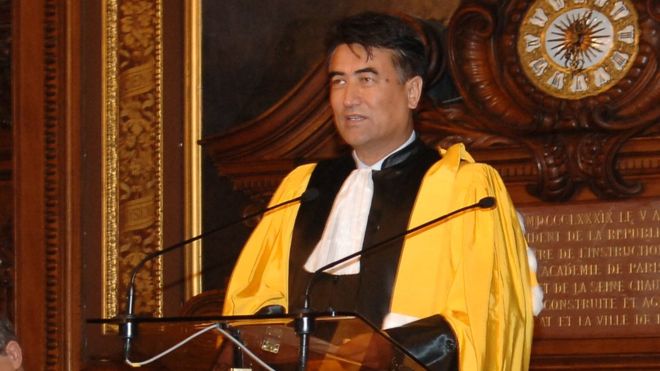
Until 2017, Tashpolat Tiyip was a model academic, head of Xinjiang University, globally connected, and with an honorary degree from a prestigious Paris university.
But that year, without warning, he disappeared, with no word from officials. His friends believe that after a secret trial, Prof Tiyip was convicted of separatism and sentenced to death.
Prof Tiyip is a Muslim Uighur, and rights groups say he was caught up in a wider persecution of Uighur intellectuals as China tackles what it says is a separatist, terrorist threat.
"There are hundreds of Uighur academics and professionals swept up into this mass internment campaign," Michael Caster, a researcher and author of The People's Republic of the Disappeared, told the BBC.
"This is targeting community, cultural, and intellectual leaders; it is tantamount to cultural genocide."
Fellow academics fear that if he is still alive and detained, Prof Tayip faces imminent execution.
Who is Tashpolat Tiyip?
Until his disappearance, Tashpolat Tiyip was an esteemed professor of geography at Xinjiang University, which like all Chinese universities is an official state institution.
A member of the local Uighur community in Xinjiang, he had studied geography in his home province, and after a stint in Japan, returned home to his alma mater to teach.
He'd been active in international academic circles - receiving a title from France's Ecole Pratique des Hautes Etudes - and was part of a tight-knit international network of scholars in his field.
He was also a member of the Chinese Communist Party and in 2010, he became president of Xinjiang University, a position he held until his disappearance.
How did he disappear?
The proceedings against Prof Tiyip were shrouded in secrecy and there's no official record of what happened to him.
Friends say that in 2017, he was on his way to Europe for a conference and to launch a co-operation with a German university. But at Beijing airport he was stopped and told he had to return to Xinjiang's capital Urumqi. That's where the trail ends, a former colleague of the professor told the BBC from the US.
He never returned home and his friends and relatives were soon questioned over corruption allegations around him.
Eventually, the family heard news he had been convicted of separatism and had received the death penalty, the former colleague explains - but China has never confirmed anything about his case.
Working as a researcher in the US, she is herself a Uighur originally from Xinjiang and asked to remain anonymous so as not to endanger her own friends and family back home.







Monday, 27 July 2026 - 9:40
After years dominated by hyper-saturated trend cycles and sleek, ultra-smooth minimalism, fashion has...

Monday, 20 July 2026 - 9:35
The era of hyper-rigid seasonal dress codes has quietly dissolved. Where personal style once demanded...

Monday, 08 June 2026 - 18:35
There was a time when sleek, unadorned surfaces and flat printed graphics defined what it meant to be...



Tuesday, 25 August 2026

Thursday, 13 August 2026

Wednesday, 05 August 2026


Tuesday, 18 August 2026

Tuesday, 28 July 2026

Monday, 20 July 2026

Friday, 15 May 2026