
Latest News

Andrea Dovizioso’s choice of a soft rear with set-up changes for the wet track helped move him to the front at Valencia.
Monday, 26 November 2018 - 16:57 | Views - 686
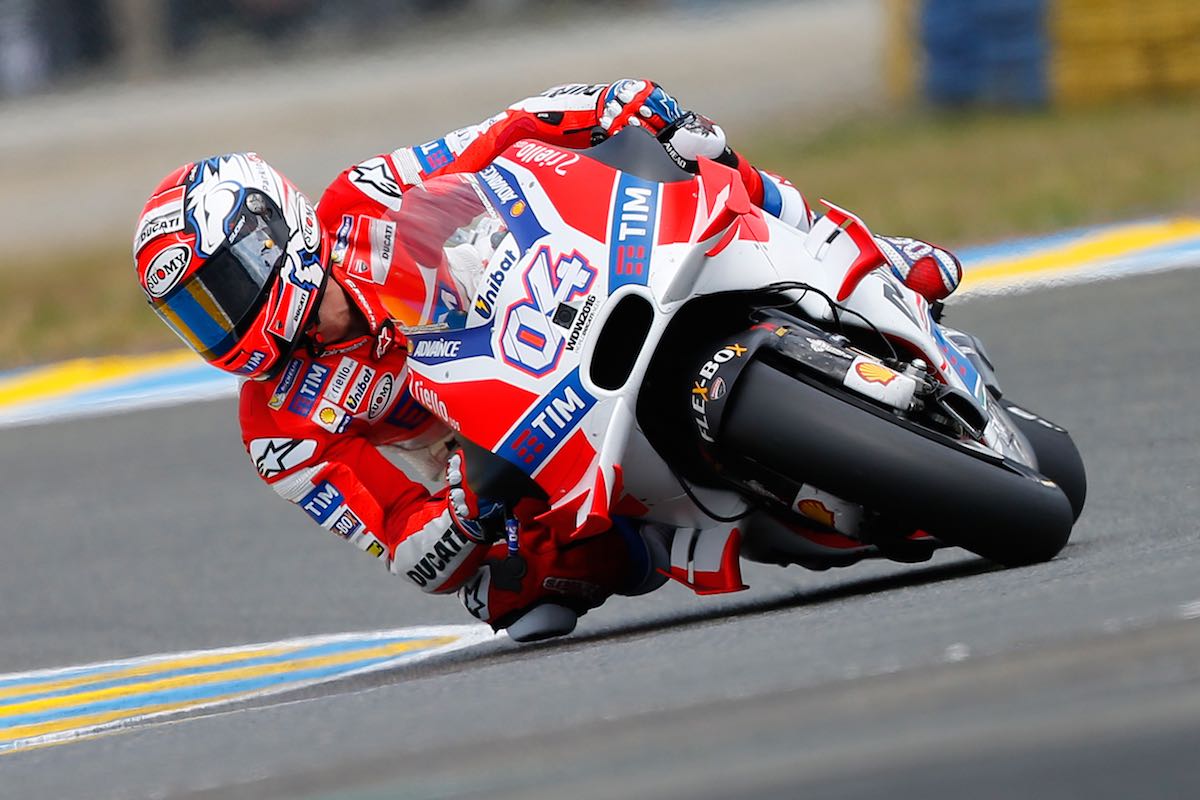
Andrea Dovizioso on the 2018 Ducati prevailed against heavy rain and a stopped and restarted race to win the last event of the 2018 MotoGP season. A part of his strategy was to hold back a soft rear wet tire and make set-up changes to make its life tolerable.
Valentino Rossi, who had been third at the stoppage and who in race 2 fell after pushing past Álex Rins for second, said of Dovi, “Dovi had a new front and they put on the soft, which is the right tire. But also he had a new soft rear. I don’t understand where he hid that tire!”
Rins made a fast getaway at the restart, but the combination of Ducati’s excellent rain software and great power put Dovi in the lead as lap two began. The three riders—Dovi, RIns, and Rossi—now pulled rapidly away from the rest and by lap six, Dovi had a second on Rins with Rossi just a half-second behind him and moving up. Two laps after passing Rins, Rossi was off at turn 12, leaving Dovi with a comfortable 2.4-second lead.
With the championship already decided, all this was anti-climax, but Valencia is always anticipated with great interest because of the Tuesday/Wednesday test of 2019 prototypes that comes next.
With only short dry periods it had been a wet weekend, and Sunday’s race itself was red-flagged, when after 15 laps the on-track water depth overwhelmed drainage. The result was hydroplaning and a rash of crashes that took down nine riders, including new MotoGP world champion Marc Márquez. The race order was backdated to lap 12, which meant riders who had fallen before that were excluded from the restart. Sixteen riders participated.
The restart order was Rins, Dovi, Rossi, Dani Pedrosa, and Johann Zarco.
As usual, Márquez was regarded as “having something extra” through practice, but made a mistake in choosing a medium rear on the grid for race 1. This tire had worked well for him in FP3, with less water on the track, “…and when we went out from the box today there was not so much water.”
“On the grid all the team—Santi, Alberto—said to me, ‘If it starts to rain, with the soft you [would be] okay.’
“I said put in the medium.
“…but when we started the race, a big rain started… The rear [tire] temperature was going down and down, and then I crashed.”
Scott Redding felt the same: “I think that my biggest limitation today was the rear tire cooling down.”
Dovizioso on Friday had lacked feel at the rear of his Ducati: “I didn’t have enough feeling on the rear to release the brake and make the speed in the middle of the corner.
“We did some changes to the setup because Valentino was so much faster in braking and entering corners. The reason I couldn’t be stronger like him was the rear, so we did something to be able to brake a bit harder.
He also emphasized the importance of the rider’s mentality in the race, rather than his lap times in practice. Many times riders who are fast in practice are unable to summon the self-discipline required to keep a competitive pace.
Maverick Viñales had trouble with his traction control in race 1. It was killing power in third gear, then oversupplying it in fourth. After six laps he “got the hang of it” and was able to push, then crashed. Jack Miller saw the action: “…Maverick crashed almost in a straight line,” implying that the cause was probably aquaplaning. Miller’s view was that Race Direction might have been trying to keep race 1 going long enough to declare it final.
Viñales’ crew had fitted a shorter swingarm, suggesting they moved weight aft. In slippery conditions, a shorter arm can make a bike transfer weight, hook up, and accelerate, rather than spin. The other changes usual for a rain setup are to increase mechanical grip by using softer spring and damping rates (the softer the spring, the less severe the disturbance to the bike from bumps). Such softer rates are not usable in the dry because they bottom more easily. To preserve the corner stability of Yamaha’s wheelbase, the front end was probably moved forward within the steering head (racebike steering heads are quite large in diameter to allow not only changes in rake angle, but also in fore/aft position).
The Yamaha team has now taken stock of its recent improvement. “We tried to work on the chassis, on the weight distribution, when [in my view] we had to work more in other areas like the electronics and engine,” Rossi said.
A different engine spec is expected in the 2019 package, which is hoped to combine competitive power with the kind of smoothness that can be properly civilized by the 10-year-old electronics that the paddock is now required to use.
Rossi recalled that “…it was a nightmare because the 2017 bike was very difficult to ride in the wet.”
Some believe that Yamaha may have embraced the “philosophy” of Dorna’s spec software and ECU rather than try by every means possible to circumvent it. It has been suggested that some teams have augmented the limitations of “DornaWorld” by creative use of the signal-processing computer that is packaged with every IMU. Moral high ground or podium: pick one.
With the electronics development done by Yamaha in the latter part of this year, Rossi said the 2018 bike was more like the bikes of 2015/2016 when “…we were quite strong in the wet.”
Rins, second behind Dovi, managed a bland, “I’m very happy for this podium [as] the track was dangerous and slippery.
“I think we did an incredible season: five podiums for me, nine for Suzuki…”
Great credit to Suzuki for its rapid development this year.







Monday, 27 July 2026 - 9:40
After years dominated by hyper-saturated trend cycles and sleek, ultra-smooth minimalism, fashion has...

Monday, 20 July 2026 - 9:35
The era of hyper-rigid seasonal dress codes has quietly dissolved. Where personal style once demanded...
Monday, 08 June 2026 - 18:35
There was a time when sleek, unadorned surfaces and flat printed graphics defined what it meant to be...



Tuesday, 25 August 2026

Thursday, 13 August 2026

Wednesday, 05 August 2026

Tuesday, 18 August 2026

Tuesday, 28 July 2026

Monday, 20 July 2026
Friday, 15 May 2026