
Latest News

Brief History Of Kashmir Shawls
Monday, 24 June 2019 - 15:59 | Views - 1,376
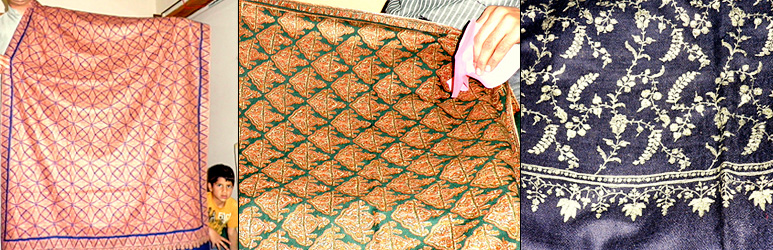
The origin of shawls in the world can be traced back more than 700 years. However it has not been confirmed as to when and where the first shawl was made and in fact by whom. It was Zain-Ul-Ahadin in mid 14th century who introduced the art of weaving in the Kashmir valley.
The Embroidered shawl was the creation of a peasant called Ali Baba. Allegedly Ali Baba once noticed the imprint of a fowl's feet left on a white sheet and he proceeded to embroider the outline with coloured thread to enhance the effect and that is how the embroidered shawls were introduced. Silk and cotton thread is used for embroidery. The artisan has to twist the raw silk until it fits the eye of the needle. The workmanship is so intricate and time consuming that some embroidered shawls take 2 to 4 years time to complete.
The first record comes from the Mughals period. By the 16th Century the Kashmir shawl industry was an old and well-established one. King Akbar encouraged and promoted the manufacture of shawls in Kashmir. He also presented a gift of Kashmir jamawar shawl to the Queen of England. Fabrics Bernier description of shawls in the late 17th Century, leaves us in no doubt that he is referring to the same pashmina shawls that became famous as Kashmir (Cashmere) Shawls. It became a highly fashionable and stylish garment when Empress Josephine famously received Kashmir shawls as gifts from Napoleon.
The shawls became a favoured item in the wardrobe of every fashionable woman in Europe, particularly in France. The Industry flourished during this period. The Industry suffered through the reign of Afghan and then Sikh rule. This was a period in Kashmir history where there was a marked decline in crafts. However, in the late 18th Century during the reign of Maharaja Ranbir Singh, the trade picked up. In the early 19th Century the shawl exhibitions in the European market helped to create awareness and promote Kashmir shawls again throughout the world.
Pashmina refers to a type of cashmere wool made from it. The name comes from Pasmineh originate from the Persian word for wool pashm . This wool comes from changthangi or ladakh or pashmina goat, a special breed of goat indigenous to high altitude of the Himalayas.
The high Himalayas has a harsh, cold climate and the goats , who have developed an exceptionally warm fine light fibre coat, shed their winter coat every spring and the fleece is caught on thorn bushes. Villagers would scour the mountainside for the finest fleece to be used.
The pashmina goat in that freezing environment grows a unique, incredibly soft coat called pashm, which is six times finer than human hair. It is so fine that it cannot be spun by machines, so the wool is hand-woven into cashmere products including shawls, scarves, wraps, throws, stoles etc. for export worldwide.
Cashmere shawls have been manufactured in Kashmir for hundreds of years.







Monday, 27 July 2026 - 9:40
After years dominated by hyper-saturated trend cycles and sleek, ultra-smooth minimalism, fashion has...

Monday, 20 July 2026 - 9:35
The era of hyper-rigid seasonal dress codes has quietly dissolved. Where personal style once demanded...
Monday, 08 June 2026 - 18:35
There was a time when sleek, unadorned surfaces and flat printed graphics defined what it meant to be...



Tuesday, 25 August 2026

Thursday, 13 August 2026

Wednesday, 05 August 2026


Tuesday, 18 August 2026

Tuesday, 28 July 2026

Monday, 20 July 2026

Friday, 15 May 2026