
Latest News

History of Wristwatches
Monday, 11 March 2019 - 15:57 | Views - 885
Wristwatches
The first wristwatch was created in 1812, to fit the wrist of the Queen of Naples, however, they had previously been introduced in the 1570s but were described as an arm watch. Wristwatches were primarily worn by women as the watches were prone to damage by the elements, which is why men wore pocket watches. Wristwatches became more popular for men in the military. In 1880, Constant Girard, of Girard-Perregaux, mass produced two-thousand wristwatches for German Naval Officers. Brazilian aviator Alberto Santos-Dumont was in search of a watch that would allow him to keep both hands on the controls while timing flights. He reached out to good friend Louis Cartier to come up with an alternative. Cartier and his watchmaker Edmond Jaeger developed the Santos wristwatch, popularized by Santos-Dumont wearing it during his flights.
World War I
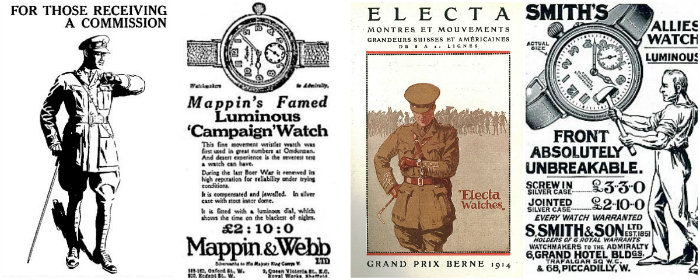
During the first World War, a pocket watch meant that to keep an eye on the time, soldiers could not fully carry all of their equipment. To keep their hands free, they were given wristwatches called “trench watches.” These early wristwatches were made with pocket watch movements, some brands would put the crown at 12 o’clock while others moved it to 3 o’clock. They were worn on leather straps and allowed for accurate coordination of maneuvers and attacks. Wristwatches became part of the Officer’s Kit for the war front. They were required to have a luminous wrist watch and unbreakable crystal, which were also to be purchased individually rather than supplied by the military. Because the men were to purchase their own watches, there were many adverts seen all over which helped popularize wristwatches.
Modern Developments
In 1930, the first stopwatch was patented by the Breitling Watch Company even though they were originally invented in the 1770s. The chronograph, while similar to a stopwatch, measures time in addition to recording time increments. Electric watches were introduced in the 1950s. The hands were moved mechanically yet the balance wheel was powered by a solenoid, a thin wire wrapped around a metallic core producing a magnetic field when an electric current is passed through. These electric watches foreshadowed the quartz watch, introduced in 1969. The quartz watch removed all moving parts found in mechanical watches, replacing them with a battery. This meant that the watches became more shock absorbent and could maintain better accuracy with no cleaning or oiling. These quartz watches were driven by a battery powered circuit rather than a self winding movement. Quartz watches used digital counters rather than a wheel train to add up beats to track the time, this is still found in quartz watches today.
Non-quartz watches are still manufactured today, mainly by luxury Swiss brands. Many are created by hand still and feature hand polished surfaces from the dial all the way to the smallest screws. The production of these watches is a true art-form that not many people possess.
The Future of Watches
Silver, stainless steel and gold have all been common watch materials, companies have experimented utilizing titanium and carbon fibre in their case designs as well as using aluminum and platinum. In more recent years, watches have been made with even more high tech materials including silicon and ceramic. Some of these materials are also found in the watch movements, not just the cases.







Monday, 27 July 2026 - 9:40
After years dominated by hyper-saturated trend cycles and sleek, ultra-smooth minimalism, fashion has...

Monday, 20 July 2026 - 9:35
The era of hyper-rigid seasonal dress codes has quietly dissolved. Where personal style once demanded...

Monday, 08 June 2026 - 18:35
There was a time when sleek, unadorned surfaces and flat printed graphics defined what it meant to be...



Tuesday, 25 August 2026

Thursday, 13 August 2026

Wednesday, 05 August 2026


Tuesday, 18 August 2026

Tuesday, 28 July 2026

Monday, 20 July 2026

Friday, 15 May 2026