
Latest News

Why North Korea's cruise missile launch could worry other nations
Saturday, 18 September 2021 - 11:19 | Views - 426
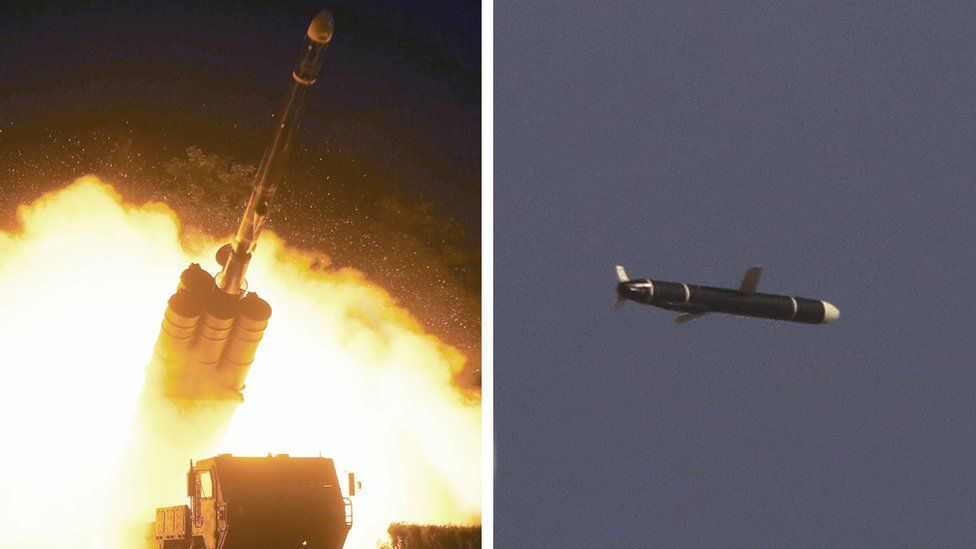
Earlier this week, North Korea announced it had successfully tested a long-range cruise missile capable of hitting much of Japan.
Cruise missiles, unlike ballistic missiles, can swerve and turn through most of their flight - allowing them to attack from unexpected angles.
It shows North Korea is continuing its pursuit of ever more diverse and sophisticated means to deliver nuclear weapons.
It's clear the pandemic, a spate of natural disasters, and internal economic difficulties have done little to deter North Korea's fundamental prioritisation of its nuclear deterrent.
The latest successful test brings up a series of questions - why is North Korea doing this now, how significant is this, and what does it tell us about its priorities?
Pyongyang remains unshifting
North Korea has broadly been on a trajectory of qualitatively refining and quantitatively expanding its nuclear capabilities since the spring of 2019.
North Korean leader Kim Jong Un, since returning from the failed February 2019 summit with former U.S. President Donald J. Trump in Hanoi, Vietnam, expressed resolve to continue investing in North Korea's nuclear deterrent and pursuing a "self-reliant" national defence strategy.
But why is North Korea choosing to do this even as it struggles through food shortages and a deepening economic crisis?
It serves multiple ends.
Internally, these tests amplify Mr Kim's narrative of pursuing self-reliance in national defence and bolsters morale.
In practical terms, new capabilities, like these cruise missiles, complicate planning by North Korea's adversaries, who must now contend with new capabilities.
Unlike ballistic missiles, cruise missiles fly low and slow towards their target.
The cruise missiles North Korea tested recently covered a range of some 1,500km (930 miles) over a little more than two hours of flight time.
Ballistic missiles of equivalent range would take a matter of minutes, but North Korea's interest in cruise missiles may be due to the difficulty for its adversaries in detecting their launches and in defending against them.
And what these tests show is that Mr Kim - despite openly contending with the country's difficulties - has maintained his determination to continue advancing his nuclear capabilities.
Unless we see a fundamental shift in priorities by North Korea or successful diplomatic outreach by the United States, Pyongyang should be expected to continue refining and advancing its capabilities.
But is it notable that North Korea chose to introduce this weapon system at this point in time?
Despite commentary to the contrary, the introduction of this weapon system and its testing likely have little to do with the policy specifics of the Biden administration or the twentieth anniversary of the September 11, 2001, attacks on the United States, which coincided with these recent tests.







Monday, 27 July 2026 - 9:40
After years dominated by hyper-saturated trend cycles and sleek, ultra-smooth minimalism, fashion has...

Monday, 20 July 2026 - 9:35
The era of hyper-rigid seasonal dress codes has quietly dissolved. Where personal style once demanded...

Monday, 08 June 2026 - 18:35
There was a time when sleek, unadorned surfaces and flat printed graphics defined what it meant to be...



Tuesday, 25 August 2026

Thursday, 13 August 2026

Wednesday, 05 August 2026


Tuesday, 18 August 2026

Tuesday, 28 July 2026

Monday, 20 July 2026

Friday, 15 May 2026